
Outdoor garage lights do much more than make a driveway glow. The right fixtures create welcoming curb appeal, deter intruders, guide safe footing at night, and tie together the architectural story of a home. Whether the garage faces a busy street or sits back on a long driveway, well-planned illumination turns a dark façade into a confident, attractive feature that works every evening and stands up to harsh weather for years. Thoughtful choices around fixture type, placement, and performance transform exterior lighting from a simple utility into a design asset.
From barn-inspired goosenecks to clean-lined sconces, today’s outdoor garage lights deliver robust output, energy efficiency, and finishes that complement everything from modern farmhouses to mid-century bungalows. Balancing form with function is the goal: enough lumens for safety, control of glare for comfort and compliance, and durable construction that resists rust, corrosion, and fading. With a few guiding principles—and examples that mirror real-world conditions—it’s easy to specify a lighting plan that looks great and performs even better.
Choosing the Right Outdoor Garage Lights: Form, Function, and Performance
Selecting fixtures begins with the garage’s architecture and how the space is used after dark. For character and coverage, gooseneck barn lights with deep shades project light forward and down, ideal for wide driveways or double doors. Compact wall sconces work beautifully between doors or beside a single bay, while carriage-style lanterns suit traditional façades that benefit from visible glass and filament-style LEDs. Flush or semi-flush shades under eaves can add a soft wash without cluttering the wall plane. Each style contributes differently to the beam, glare control, and aesthetic, so it pays to map looks to tasks.
Performance specs matter as much as style. Aim for LED fixtures with 800–1,200 lumens for single-bay garages and 1,600–3,000 lumens total for double doors, depending on mounting height and ambient light. A color temperature of 2700K–3000K offers welcoming warmth that flatters siding and stonework, while 3500K–4000K can feel crisp and modern near concrete or metal cladding. A high CRI (90+) helps colors read accurately on vehicles, house numbers, and landscaping. Deep, shielded shades or barn-style reflectors keep light aimed downward to reduce spill and glare—an important element for neighbor-friendly and Dark Sky–minded designs.
Durability is non-negotiable. Look for wet-location ratings for fully exposed walls, powder-coated steel shades to resist chipping and UV fade, and sealed sockets or gaskets to keep out rain, dust, and coastal air. Heavy-gauge steel and robust arms on goosenecks prevent sag over time, and a quality finish ensures easy seasonal cleaning. In snow belts and humid coastal zones alike, rugged construction is the difference between lights that merely survive and lights that stay beautiful. When you’re ready to explore silhouettes, finishes, and sizes that blend charm with muscle, browse curated collections of outdoor garage lights to zero in on the right fit.
Controls complete the equation. Motion sensors provide a quick burst of brightness when someone approaches, helpful on side doors or secondary bays. Dusk-to-dawn photocells automate everyday on/off without a smart system, and dimmable drivers let you trim brightness for late-night ambience. In many neighborhoods, a lower overnight level paired with motion-activated boost satisfies both visibility and courtesy, ensuring a safe, calm streetscape.
Placement and Installation: Height, Spacing, and Controls That Work
Even the best fixture underperforms if it’s mounted at the wrong height or too far apart. As a starting point, mount wall sconces or barn lights so the center of the light source sits about 6.5–8.5 feet above grade. This typically places a gooseneck shade 12–18 inches above the garage door header, allowing the beam to project forward and down without casting harsh shadows at the threshold. For single-bay garages, one well-sized sconce centered over the door can be effective; for double doors, flank each door with a fixture, or center one between the doors and add two more at the outer edges to create even coverage across the façade.
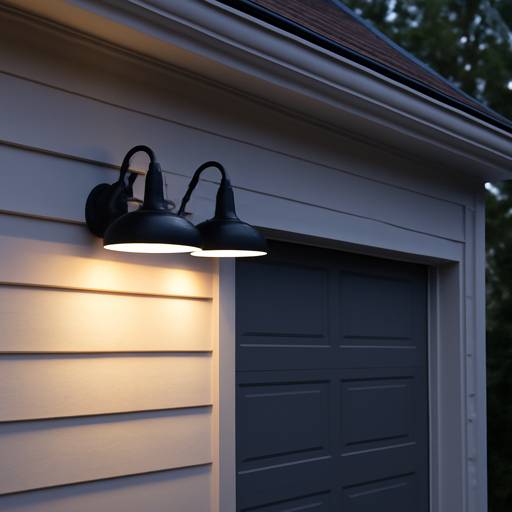
Spacing plays a role in both brightness and balance. Roughly, fixtures can be set 1/4 to 1/3 of the door width from the edges to ensure the beam overlaps nicely. If the driveway is particularly wide, consider augmenting with a soffit or under-eave downlight to bring light out toward the apron. Maintain a comfortable vertical clearance so tall vehicles do not glare the occupants as they pull in; deeper shades and careful tilt help keep light out of eyes while maximizing the lit area in front of the doors.
Real-world example: a two-car garage with a 16-foot door and a 20-foot-deep driveway may target around 1–2 footcandles across the approach. Three fixtures providing a combined 2,400–3,000 lumens—two flanking the door at 900 lumens each and one over a nearby side entry at 600 lumens—can comfortably achieve this when mounted at 7.5–8 feet with shielded shades. The result is uniform light for safe backing and walking, good recognition of faces at the door, and minimal spill into the street.
Controls and wiring should suit daily habits. A photocell ensures the lights come on at dusk, while a smart switch adds scheduling, grouping with path lights, and remote adjustment. Motion sensors on side doors are particularly effective for hands-free entry with groceries or tools. For installation, use a weatherproof, properly supported junction box; seal the backplate perimeter and fasteners with exterior-grade silicone to keep moisture out. Where local code requires, tie into a GFCI-protected circuit and maintain a neutral conductor in the box to future-proof for smart controls. Always follow manufacturer guidelines and consult a licensed electrician to meet local code and ensure the fixture’s wet rating remains intact. Proper installation is integral to both longevity and safety.
Design Details That Elevate Curb Appeal Year-Round
Great outdoor garage lights harmonize with finishes, hardware, and landscape features. Matte black shades anchor modern farmhouses and contemporary exteriors, pairing well with dark entry doors and black window grids. Galvanized or weathered steel reads classic and purposeful against board-and-batten or reclaimed brick. Soft whites brighten coastal cottages, while deep bronze suits craftsman bungalows. Selecting a shade size that fits both scale and output—often 10–12 inches for single doors, 14–16 inches for double doors—ensures the fixture feels proportional to the façade and throws the right beam.
Material quality affects more than longevity; it affects how light looks. Powder-coated steel with a fine texture diffuses any stray brightness and resists scratches from ladders or seasonal décor. Robust arms on goosenecks keep the silhouette crisp even in high winds, and sealed sockets with high-temp gaskets stand up to hot summers and freezing winters. In coastal climates, opt for corrosion-resistant finishes and schedule basic maintenance: rinse salt spray monthly, wipe dry, and apply a thin coat of carnauba wax once or twice a year to preserve the luster of the coating. Small habits keep fixtures looking showroom-new.
Layering light elevates the whole scene. Pair wall-mounted sconces with low-voltage path lights to outline a walkway, or add a subtle under-eave downlight above the address numerals for quick wayfinding. Dimming capability allows a bright welcome at early evening and a gentler glow overnight, saving energy and reducing light trespass. LED technology makes it easy to enjoy 70–80% lower energy use than incandescent, with lifespans often exceeding 50,000 hours. That’s years of reliable service with minimal lamp changes—particularly helpful on tall façades where access is tricky.
Style case studies help visualize results. A classic bungalow might use two compact sconces flanking a single carriage-style door, 2700K for warmth, with frosted glass to soften the beam. A modern farmhouse could lean on bold gooseneck barn lights in matte black, 3000K, larger 14–16 inch shades for presence, and a central motion-activated downlight over a side entry. Urban infill homes often benefit from minimalist shades in galvanized or bronze, tight beam control to respect close neighbors, and smart scheduling that balances security with subtlety. Across all approaches, the hallmarks of success remain the same: durable construction, intentional placement, well-chosen color temperature, and controls that match daily life.
When these details come together, the garage ceases to be a shadowy utility zone and becomes a confident, crafted element of the home’s exterior. The right lights make nighttime arrivals feel safe and welcoming, highlight the materials that define the architecture, and carry their good looks through seasons of sun, rain, snow, and salt air without missing a beat.

Kinshasa blockchain dev sprinting through Brussels’ comic-book scene. Dee decodes DeFi yield farms, Belgian waffle physics, and Afrobeat guitar tablature. He jams with street musicians under art-nouveau arcades and codes smart contracts in tram rides.